The Musée du quai Branly – Jacques Chirac, explained
The Musée du quai Branly – Jacques Chirac, opened in June 2006 in a Jean Nouvel building on the Left Bank about 300 m from the Eiffel Tower, holds some 370,000 objects from Africa, Asia, Oceania and the Americas, shows roughly 3,500 of them on a single gallery level called the plateau des collections, opens Tuesday to Sunday from 10:30 to 19:00 and until 22:00 on Thursdays, closes on Mondays, and admits under-18s, EU residents aged 18–25 and first-Sunday visitors without a ticket.
I ran school visits on the plateau for six years, and the question I still get most from friends passing through Paris is the simplest one: what is it, exactly? Here is the answer I give them, with the practical part at the end.
What it is, and what it is not
In its own words it is a museum of the arts and civilisations of four continents. It is not a museum of “primitive art”, a phrase the institution avoided even when it was being planned; President Chirac announced it in 1996 as a museum of civilisations and arts premiers, the public institution was created on 14 July 1998, and the doors opened in 2006. The collections came mostly from two older houses, the ethnography holdings of the Musée de l’Homme and the Musée national des Arts d’Afrique et d’Océanie, which had itself started life as the 1931 Musée des Colonies. That lineage is why the objects range from the Neolithic to the 20th century and why the museum is part of France’s ongoing restitution discussions. If the back story interests you, the history page follows it from 1931 to the renaming of the quay in 2021.
How the building works
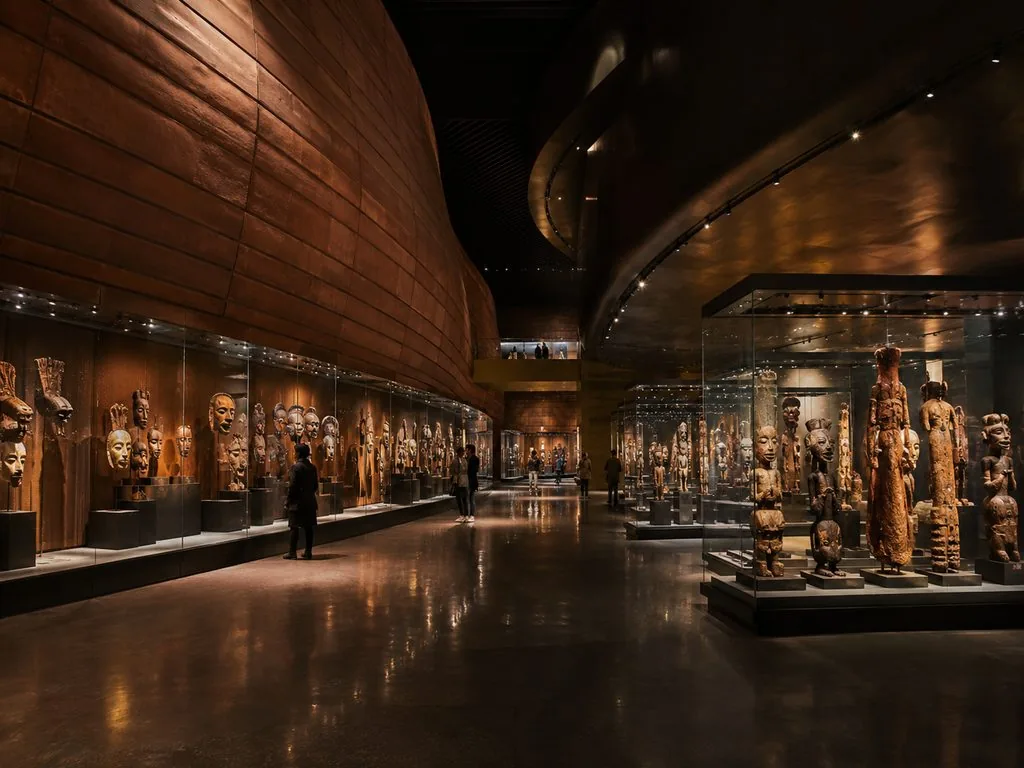
Nouvel put the museum on stilts above an 18,000 m² garden by Gilles Clément, so you approach through grasses and reeds rather than across a forecourt, with Patrick Blanc’s 800 m² green wall on the street side. Inside, a long curved ramp climbs to the plateau. A “river” of projected words runs along its floor; children like it, some adults find it a slow way to reach the art, and I have stopped defending it either way. At the top there is one gallery with no walls. It flows Oceania, then Asia, then Africa, then the Americas, and the coloured boxes you see projecting from the north facade are alcoves inside that gallery. The temporary exhibitions sit on mezzanines above the plateau and in a gallery at garden level.
How to pace it
The museum quotes 45 minutes to an hour for a group visit and up to an hour and a half with a guide-lecturer. Those are slot lengths. On your own, count on two to three hours for the plateau and more if you add an exhibition; Jean Paul, one of the GetYourGuide reviewers, wrote “allow about 3 hours minimum”, and Jean-Louis thought an art lover would want two days. My advice is to pick one continent to walk slowly and let the others go by at reading pace. Oceania is mine, for the Papuan poles and the Rapa Nui figures, but the Benin plaques in Africa and the Nazca textiles in the Americas draw the longest pauses on school visits. The how-long page has a 90-minute plan, a half-day and a full day. When you flag, Café Jacques has a terrace in the garden, and the ticket is valid all day, so you can go out and come back.
When to go
Not Monday, when it is closed, and not the first Sunday of the month unless you are there for the free entry and can live with the crowd. Tuesday and Wednesday at 10:30 are quiet. Thursday after 19:00 is quieter still, and the late opening runs until 22:00, which makes it the one Paris museum evening I recommend without hedging. Weekend afternoons and school holidays are the busiest. The garden opens at 9:15, before the building, and it is free to walk through. Full tables, including the 2026 evenings, are on the opening-hours page.
Who needs a ticket
Fewer people than you would think. Under-18s get in free, EU residents aged 18 to 25 get in free with ID, disabled visitors and a companion get in free, and everyone gets in free on the first Sunday. A temporary exhibition may still need a free timed reservation, so check the listing on quaibranly.fr. If you are a non-EU adult with a fixed afternoon and you want a slot rather than a queue, the skip-the-line admission ticket is the sensible buy: it covers the permanent collection and the exhibitions for one day, it works from your phone at the “access with ticket” entrance, and it cancels free up to 24 hours before. The ticket page goes through the combos and the Museum Pass as well. Two things trip people up at the door: bags, because suitcases and bulky objects are refused with no left-luggage, and the voucher, which one reviewer, Fran, could not get accepted at first and lost an hour over. Have it open on your phone before you reach security.
One honest criticism
The lighting is dim, by design, to protect textiles and feathers, and the plateau is arranged by theme within each region rather than as a timeline. Together they can leave a first-time visitor unsure where they are or what they have already seen. Take the free map at the desk, follow the regions in order, and treat the alcoves as chapters. Do that and the building stops being confusing and starts being the reason the museum is worth the walk from the tower; the worth-it page is where I make that case in full.
Ready to book?
The admission ticket covers the plateau des collections and the temporary exhibitions, is valid for one day, and can be cancelled free up to 24 hours before. Check today’s availability below, or compare the museum-plus-cruise combos first.
Frequently asked questions
Is the guide the same as the one on the homepage?
Yes. I keep one text and publish it in both places so nothing drifts out of date. The homepage adds the ticket comparison and reviews around it.
What should I read next?
The what to see page walks the plateau region by region, and how long to visit gives three timed plans.
Do I need a ticket to walk through the garden?
No. The garden is free and opens from 9:15. Details on the garden and green wall page.